Showing posts with label O'Dowd. Show all posts

Thursday, November 10, 2022

One Name Study (ONS) / Surname Study

I have just started a One Name Study (ONS), also known as a Surname Study for the surname Dowd. 


I have started a page on WikiTree.

Study space page:          https://www.wikitree.com/wiki/Space:Dowd_Name_Study Study category page:     https://www.wikitree.com/wiki/Category:Dowd_Name_Study

I have actually started two One Name Studies. The second one is Donoghue. 

The WikiTree pages are
Study space page:         https://www.wikitree.com/wiki/Space:Donoghue_Name_Study Study category page:     https://www.wikitree.com/wiki/Category:Donoghue_Name_Study


FTDNA  There is a group project on FTDNA for Dowd
It is located at     https://www.familytreedna.com/groups/dowd/about 

Please join this project and upload your DNA to FTDNA. 

Monday, January 4, 2021

Dowd townland and parish in County Monaghan

From the records I located in RootsIreland.ie website, I found out where in County Monaghan the family was living before coming to Canada. 

Townland: Corringshigo
Civil Parish: Currin
Co. Monaghan

To locate where these were I went to two great websites for maps in Ireland. 

Irish Ancestors
Townlands

From Irish Ancestors website we can see that in County Monaghan, Currin parish is number 6 and is located in west of the county. 


From the Townlands website we can also see where the civil parish of Currin is located. 


Source: https://www.townlands.ie/monaghan/currin2/

From the Townlands website we can see where Corrinshigo townland is within the parish. It is located in the NW corner of the parish. 


From the GeoHive website, this map lists the Townlands around it and what the land looks like.
As the townland is close to County Cavan this map shows parts of both counties. 


Source: http://map.geohive.ie/mapviewer.html?webmap=de86a2ef188a49e3a3b7a88ef1876574


RootsIreland.ie website update

For my BYU-I British Isles course I had to get a subscription to RootsIreland.ie website. When my course finished I wanted to search for my own family as much as possible before the subscription ran out. In this blog post I not only share how exciting this was to find proof and family records but also the steps used when searching a family on a website by using multiple searches strategies. 

Background Information
From my family, I was given the following information. Richard Dowd and Mary Donaheau married 1824 in Ireland. I was also given the following children. They had Elizabeth (22 Jan 1825), Jane (1827), MaryAnn (abt 1829) and Richard (1832) in Ireland before coming to Canada in 1841. In Canada they had Robert James (8 May 1842 Quebec, Canada) and Margaret (1829 Ireland). Margaret was listed as the sixth child and that she was born in Canada but birthdate is given too early and in Ireland. I will come back to this later. 

There was confusion in the information I was given as to Mary's maiden name. Donaheau or Summerville/Somerville, although it was later stated that Summerville was her mother's maiden name. 

Search for individual records
I searched on the RootsIreland website for each of the family members' baptism record with the father's first and surname, the mother's first name, the child's name and the year born with +/-5 years. I was so excited to find the first three of the children listed. 

Eliza Dowd


I was given the information that Elizabeth was born 22 Jan 1825 Monaghan. 

Note the date of the baptism. 


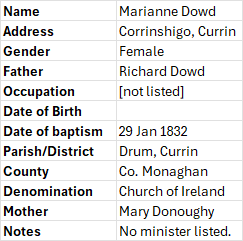
Marianne Dowd


I was given the information that Mary Ann was born about 1829 in Monaghan. 

Note the spelling of her first name

Note the date of the baptism. 


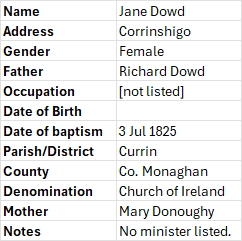
Jane Dowd


I was given the information that Jane Dowd was born in 1827 Monaghan.

 
Note the date of the baptism. 
Parish is consistent. 


The records for all three girls spelled Mary's last name as Donoughy, verifying the correct maiden name but Richard did not show up. 

Search by parents
Now I knew how Mary's surname was spelled and I knew there was another child, I searched for baptism records with the father and mother's names only. I did not enter a child's name in the search field. I found another son, who was not recorded in family records! Thomas Dowd.  The mother's name this time was give as Donahoo. The spelling was close enough that the search engine picked it up. 

Thomas Dowd


I was so excited but I still didn't have Richard but sometimes not all children are recorded even for Church of Ireland records. Another possibility is that he was baptized Thomas. This baptism is later than what I was given, so I believed Thomas is another child, and it is always good to search in a variety of ways.

Surname Index
As time is running out, I decided to use the websites surname index. They did not have Dowd in their list by itself, so I searched for any baptism in County Monaghan with the surname Dowd. There were 6 pages, of 10 on each page, of names listed chronologically starting in 1820. I found Richard and another daughter!

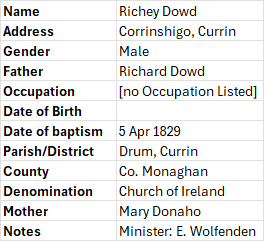
Richey Dowd


I had tried Rich* but that had not worked on this site. 


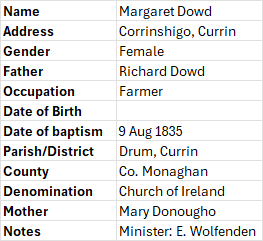
Margaret Dowd


I would not have found these two (Richy and Margaret) if I had not tried searching for just the surname. 


The Margaret I mentioned above appears here in Ireland. Did this one die in Ireland and another daughter born in Canada named the same
or is this the one I was given?

I do not know... yet.


As I went through the surname list, I also saved Dowd families in the same townland and was able to construct a Family Group Record for them, as there is a chance they are related. One name was a Robert son of Hamilton Dowd. One of my Dowd family is a Robert Hamilton. Because of naming traditions I knew I should record this family for future reference. 

Death records
I searched for any death records for Dowd in County Monaghan. No death records were available for any Dowds in County Monaghan. Therefore, at this time I do not know what happened to the two children Thomas or Margaret. Death records were not recorded often for anyone or any religion in Ireland so this is not a surprise. 

Here is the summary and list of the children born in Ireland. There is a Robert James born in Canada and possibly another Margaret. 

Parents: Richard and Mary (Donoughy) Dowd

Eliza Dowd
Bap: 26 Jan 1823

Jane Dowd
Bap: 3 Jul 1825

Richard Dowd  (Listed as Richey)
Bap: 5 Apr 1829
(Father’s name Richey, Mother’s surname Donoho)

Marianne Dowd
Bap 29 Jan 1832

Thomas Dowd
Bap: 9 Aug 1835

Margaret Dowd
Born: 10 Feb 1839
Bap: 22 Feb 1839
(Mother’s surname Donogho)

Each record records the following information:

Religion: Church of Ireland
Townland: Corringshigo
Civil Parish: Currin
County Monaghan

I now know where in County Monaghan they are from with the parish name. This will be a great help to find more information. 

Information given to me from family is that the family immigrated to Quebec, Canada in 1841. Robert was born in Quebec in 1842. Margaret is the last child I found for this family on the RootsIreland.ie website which seems to confirm this but the next step is for me to obtain a copy of Robert's birth record, Margaret's birth certificate, and immigration information. 


Saturday, March 26, 2011

Arms
Coat of Arms of the O'Dowd Clan
O'Hart records two arms for the O'Dowd Clan. One in what is today County Mayo (the senior branch) and the other in Sligo.

Princes of Hy-Fiachra (Mayo)[1]
ARMS - Vert a saltire or, in chief two swords in saltire, points upwards, the dexter surmounted of the sinister argent, pommels and hilts gold.
CREST - over a coronet, a dexter hand in armour, holding a dart, proper.
SUPPORTERS - two lions rampant
MOTTO - "Virtus Ipsa Suis Firmissima Nititur Armis" (Bravery is Best Sustained by Arms).

Princes of Hy-Fiachra (Sligo)[2]
ARMS - or a saltier sable, in chief two swords in saltier, points upwards, the dexter surmounted of the sinister argent, pommels and hilts gold, in base and oak leaf, the stalk upwards, vert.
CREST - over a coronet, a dexter hand in armour, holding a dart, proper.
SUPPORTERS - two lions rampant
MOTTO - "Virtus Ipsa Suis Firmissima Nititur Armis" (Bravery is Best Sustained by Arms).

Source:
http://en.wikipedia.org/wiki/O


^ "Irish pedigrees: or, The origin and stem of the Irish nation, volume 1" by John O'Hart (page 650), James Duffy and Co. Limited, 5th Edition, 1892.
^ "Irish pedigrees: or, The origin and stem of the Irish nation, volume 2" by John O'Hart (page 329), James Duffy and Co. Limited, 5th Edition, 1892.
"The O'Dubhda Family History" By Conor MacHale, Clan O'Dowd Historian, Inniscrone, 1990.
"The Royal New Zealand Fencibles 1847 - 1852," ISBN 0-473-04716-0, Ruth Alexander, Alan la Roche, Gail Gibson. The New Zealand Fencible Society (Inc), 1997. O'Dowd family papers.
Modern Clan O'Dowd Chieftains

Thomas J Dowds Clan O'Dowd Chieftain 1997-2003 Tom Dowds was elected as the Clan Chieftain at the Clan Rally in 1997, and served the Clan in that appointment until 2003. Descended from the O'Dowds of Kilglass, Thomas's grandfather, Patrick left Easkey for Scotland and his father, also Thomas, was born in Glasgow, but the family returned to Ireland and he was brought up in Easkey. The family again moved to Scotland in the 1920s and settled in Govan. Thomas (the Clan Chieftain), was born in England in 1937, but educated in Scotland at St Anthony's Primary and St Gerard's Secondary schools in Govan, before choosing a career in education.

In 1968, Thomas graduated BA (Hons) in Economic History from the University of Strathclyde and gained the Teachers Secondary Certificate from Jordanhill College and the Diploma in Education from the University of Glasgow in 1969.

Thomas married to Cathie (née Harvey) and had two sons and a daughter and three grandchildren. His interest in Irish, and particularly O'Dubhda history resulted in his being one of the first members of the O'Dubhda Clan Association in 1990, and he has attended every rally since. In 1997, he was chosen as the Taoiseach-elect when the Chieftainship was restored, and in September 2000 was inaugurated with Brehon rites at Cahir Mor as The O'Dubhda - the first chief in over 400 years. At the same meeting, Richard F Dowd of New Jersey was chosen as the Tanaiste. During his period in office he has represented the clan at the 1798 Bicentennial celebrations and at the unveiling of the memorial to Baron James O'Dowda, while at the same time making efforts to contact O'Dubhda clansmen worldwide. In September 2003, he handed the white staff of office, the O'Dubhda standard and the Chief's personal pennant to his successor, Richard F. Dowd.

Richard F Dowd Clan O'Dowd Chieftain 2003 -
Richard Dowd is descended from Thomas Dowd, one of a family of brothers who left Ireland to escape the aftermath of the Great Famine. It is believed that the Dowds were originally from Mayo. The family settled in the United States and Richard was born in Brooklyn, New York City of 24 November 1928.

He was educated at St Johns University, New York City and graduated with the degree of BA in 1957. During his career, he undertook further studies at the New York University Graduate School of Business Administration, gaining the degree of MBA in 1964, and PhD in 1976, for a Doctoral Dissertation entitled, "Efficiency in Government Spending."

After serving as an Engineer with the US Merchant Marine (1946-48), Richard moved to United Airlines, where he was a Radio Electric Mechanic from 1951 to 1957. After graduating from university he became a Security Analyst with Merrill Lynch (1957-60) before setting up his own business, R F Dowd & Company Inc, becoming President of the Investment Banking firm. In 1963 he moved to Value Line Investments as a Security Analyst and remained with them until 1965. In 1963, he was aappointed Professor of Economics at the City University of New York, which post he held until his retirement in 1992.

Richard spent many holidays in Ireland and was keen to trace his family's roots, which he discovered lay in the West of Ireland. The founding of the O'Dubhda Clan Association in 1990 was of great interest to him and he was a member right from the start and has not missed one Rally since. At the 1997 Rally, he was elected Tanaiste (Heir) to the Chieftain and was formally installed in that post at Cahir Mor in September 2000. In September 2003, he received the white staff as he was inaugurated as the Taoiseach of the O'Dubhda Clan, and Edward O'Dowd of Chicago was elected Tanaiste (Heir).

Possible Family Connections

Nottingham O'Dowds
Formed Pre WWI the Nottingham O'Dowds are a large Family, whose siblings increased incrediby. Edward O'Dowds Grandfather moved from Ireland at an unknown date. He went on to marry Lucy and between them had 9 children. Two girls and seven boys, the eldest also named Edward now deceased. Ehe eldest daughter is Joyce followed by Patrick O'Dowd now residing in Southampton.The names of the rest of the Nottingham O'Dowd children are Terry. Peter,Barry Diane Tony and Trevor. There are estimated to be around 20 families of O'Dowd in and around Nottingham to this day. The most famous family being associated with the Nottingham Brady Family.

Argentine O'Dowds
There are at least three families named Dowd (or O'Dowd), whose descendants are currently living in Argentina. One family descends from James Dowd who was born in Dublin in 1828, and who is recorded as marrying Mary Ann Heery. Another family descends from Michael Dowd who was born in Westmeath in 1824, and he is recorded as marrying Eileen Burke. The third family descends from another Michael Dowd who is said to have been born in Ireland in 1804.

New Zealand O'Dowds
The New Zealand branch of the O'Dowds (and Dowds), are descended from Patrick O'Dowd and Anna (née: Kenny). Patrick O'Dowd was born in Easky, Sligo in Ireland in 1805. He enlisted into the 97th Regiment of Foot (The Earl of Ulster's - also known as the "Celestials" due to the colour of their flashes on their uniforms) in 1824, aged 16. He was a Private and served 16 years in the British Army, including 11 years with the Regiment in Ceylon. Upon his retirement from the British Army he was living in Manchester with his wife Anna and 4 children. He enlisted into The Royal New Zealand Fencibles (from the word defencible) and sailed for New Zealand from Gravesend on the 1 July 1847, with his family aboard the "SS Minerva," arriving in the Port of Auckland 8 October 1847. This was the 2nd Detachment of Fencibles and included 80 Fencibles, 67 wives and 145 children.

There are about 180 families living in New Zealand, mainly in the Auckland region who bear the surname O'Dowd or Dowd. Craig Dowd the well known All Black is one of these descendants. Sacramento California America—Kathleen anne julie vivian caro[dowd]

O'Dowd Castles

O'Dowd Castles
The kingdom of the O'Dowds was ringed by 20 castles, most of which are now in ruins. The location of these castles are as follows: No:1 Lough Conn; No:2 Mount Balcon, River Moy; No:3 Beaufield; No:4 Belleek Castle, Ballina; No:5 Castleconor, River Moy; No:6 Castleton Manor; No:7 Enniscrone; No:8 Carahduff; No:9 Rathlee; No:10 Rosslee, Easkey; No:11 Dromore; No:12 Doonecoy; No:13 Cartron; No:14 Dromard; No:15 Lomford; No:16 Flooneen; No:17 Ballymote; No:18 Markcree; No:19 Lough Gill; No:20 Drumcliff Bay.

These castles and ruins were researched and located over many years by the Clan O'Dowd historian, Conor Mac Hale. The O'Dowdas (O'Dowds) were chieftains of west Sligo in Anglo-Norman times and they built the Castle in Ballina, Co Mayo in 1447. The O'Dowds occupied the castle until the Cromwellian era (17th century). The castle is of three stories. Two of the main features are the subsidiary turrets that are situated on diagonally opposed corners. The outside measurements are approx. 20m in length and 10m wide. The thickness of the walls varies between 1.65m and 2.13m.

The castle has been renovated over the years and two chimneys were added in the seventeenth century. Many of the original archer slits remain intact. After the eviction of the O'Dowds during the Cromwellian Plantation of the 1650s the castle and lands were given to Robert Morgan. It was used as a military site for the Williamite army during the war between the Catholic King James and the Protestant William of Orange. At the close of the 17th century the castle ceased to be inhabited.

Source:
http://en.wikipedia.org/wiki/O'Dowd

Chief of the Name

Chief of the Name
Brian Ó Dubhda; U1446.4: Brian Ua Dubda was slain by the Tir-Amhalghaidh.
Maol Ruanaidh mac Ruaidhrí Ó Dubhda, d. 1450 (18)
Domhnall Baile Ui Choitil Ó Dubhda, 1447-1454 (7)
Tadhg Buidhe mac Tadhg Riabhach Ó Dubhda, c. 1454-c.1457 (3)
Seaán Glas mac Tadhg Riabhach Ó Dubhda, c.1457-71?(14)
Éamonn mac An Cosnamhach Ó Dubhda (5 and a half weeks) c. 1466?
Domhnall Ballach Ó Dubhda, (1), c. 1472?
Brian Cam mac An Cosnmhach Ó Dubhda, (2) c.1472-c.1474?
Eóghan Caoch mac Ruaidhrí Ó Dubhda (14), c. 1474-c.1488?
Uilliam mac Domhnall Ballach Ó Dubhda, (half a year) c. 1488?
Brian Óg Ó Dubhda, (half a year) c. 1488?
Donnchadh Ultach Ó Dubhda (1), c. 1489?
Maghnus mac Tadhg Buidhe Ó Dubhda, (1), c. 1490?
Owen Caech Ó Dubhda, died 1495.
Uilliam Dubh Ó Dubhda, died 1496 (LCe;1496. O'Dubhda, Dubh, i.e. William, the son of Domhnall Ballach, died.)
Féilim mac Tadhg Buidhe Ó Dubhda, (19), c. 1490?-c. 1509?
Conchabhar mac Diarmaid mac Maol Ruanaidh Ó Dubhda (30), c. 1509?-c.1549?
Éoghan mac Conchabhar Ó Dubhda, (7), c. 1549?-1556?
Cathal Dubh mac Conchabhar Ó Dubhda, c.1556?-?
Cathal Dubh mac Conchabhar Ó Dubhda, d. 1582.
Dathí Ruadh Ó Dubhda, d. 1594.
Dathí mac Dathí Ruadh Ó Dubhda, 1591-c.1660
Dathí Óge Ó Dubhda, fl. 1656-1705.
Dominick O'Dowda, d. 1737.
Thady fitz Dominick O'Dowda, d. 1767.
James Vippler O'Dowda, Baron O'Dowda, ex. 1798.
Thady O'Dowd, fl. 1854.
James Vippler O'Dowd, d. 1865.
Esme and Abigayle O'Dowd.
The O'Dowd, fl. 2004.
See also Kings of Ui Fiachrach Muaidhe

Source: http://en.wikipedia.org/wiki/O'Dowd

O'Dowd history: on wikipedia

History

The O'Dowd clan or sept traces its descent from Fiachra, brother of Niall of the Nine Hostages, through Daithi, the last pagan King of Ireland who, legend has it, was killed by a bolt of lightning as he led an army to the foot of the Alps in 455 AD. His grandson Aillil ("Al-ill") succeeded as King of Connacht and later King of Tara until 482.

For centuries they were the leading sept of the northern Ui Fiachrach, a tribal group that occupied the modern counties of Mayo and Sligo. The Uí Faichrach provided successive kings of Connacht for a long period, but their sphere of influence became confined to North Connacht. In the late 10th century, their king was named Aedh Ua Dubhda (Hugh O'Dooda). He is recorded as having 'died an untroubled death' in the year 982, making this surname one of the oldest in Europe. His grandson, Mulrony, who died in 1005 had the title of Lord of Hyfiachrach. The O'Dowds were a maritime power of considerable ability in the twelfth and thirteenth centuries. On land they managed to hold their territory intact against the superior forces of the Burkes and Birminghams. Their territory at its widest embraced the baronies of Erris and Tirawley in Mayo and Tireragh in Sligo. They forged a kingdom in North Connacht which they ringed with 20 castles, often referred to as "10-Pound Castles," and held off all comers for centuries until the incursion of the Anglo-Normans.

The style and design of these small Irish castles is said to have originated from a subsidy of 10-Pounds which was granted by Henry IV in 1429. However, many of the O'Dowd castles have a far more ancient history of being built directly over the site of stone age and Bronze Age fortifications.

They were traditionally inaugurated as princes of Ui Fiachrach at Carn Amhalghaigh near Killala, on the east shore of Killala Bay near the border of Sligo and Mayo. They were considerably reduced by the Anglo-Norman incursion into Connacht in the thirteenth century but were still powerful and in 1354 Sen-Bhrian O'Dowd succeeded in driving all the Anglo-Norman settlers out of Tireragh for a time.

The O'Dowds are unique in having left a detailed account of the inauguration ceremony of their Taoiseach (clan leader). This was written in an ancient manuscript known as the Great Book of Lecan, written near Enniscrone in Tireragh between 1397 and 1418 and now carefully preserved in Dublin. The inaugural ceremony of each succeeding O'Dowd was presided over by a MacFirbis, the hereditary chroniclers of the clan. One of the most generous sponsors of the MacFirbis scholars was Tadhg Riabhach O'Dubhda ('Dark Teige'), who became Taoiseach of Tireragh in 1417. He is particularly remembered in this manuscript where his death is recorded at Enniscrone Castle.

The last election of an O'Dowd Taoiseach took place in 1595. By this time they were simply a client clan of the O'Connor clan of Sligo. This coincided with the Nine Years War, when the last independent Irish clans rose to resist English occupation of Ulster. The clan played an honourable role in the war, assisting Hugh Roe O'Donnell, in defending the western border of Ulster from incursions by the Earl of Essex in 1599 (most probably at the Battle of Curlew Pass). With the Irish defeat in 1603, their power rapidly dwindled and they were deprived of most of their patrimonial possessions. Daithi Óg O'Dowd, who married in 1636, was the last generation of O'Dowds given by MacFirbis in his pedigree of the clan. This also coincides with historical events - namely the Cromwellian reconquest (1642) following Ulster's 1641 revolt.

From the rarity of the surname today, one must conclude that these successive wars, particularly those in the 17th century against the English, and the subsequent savage repression, greatly diminished O'Dowd numbers along with their power and influence.

Several O'Dowds were bishops of the see of Killala. Father John Ó Duada, who was tortured and hanged in 1579, was one of the many Irish Franciscan martyrs. Many of the name appear in the ranks of the Confederate Catholics and, later in the seventeenth century, in Catholic King James II of England's army during the Williamite war in Ireland (1688 - 1691). The head of the sept at that time, who was killed at the Battle of the Boyne (1690), is said to have been seven feet tall.

The O'Dowd castle was built in Carn Amhalghaigh in 1477. The O'Dowds occupied the castle until the Cromwellian re-conquest. The castle was used as a Williamite military base during the later war and ceased to be inhabited shortly thereafter. A smaller keep was built at Castleconner near Ballina in 1520 by Conor O'Dowd, the Taoiseach of the time. Both castles are now in ruins.
The noted Irish genealogiest, Dubhaltach Mac Fhirbhisigh, was the last of the 'senchai' or hereditary historicans to the family. He was murdered in 1671.

Source:
http://en.wikipedia.org/wiki/O

Friday, December 31, 2010

Dowd name in Ireland

O'Dowd was the name before Dowd and O'Dubhda before that which is the Irish name. They claim descent from Irish Rayalty. It is said to mean "The Dark One". The first King being Aodh O'Dubhada (Ca. 982), King of Connacht.

By the 19th Century most bearers of the name Dowd were by proportion 4 to 1 Dowd. At the turn of the centruy they added O'Dowd. Originally O'Dubhde from dubh meaning Black (Gaelic). They are the tribe which he was brother to what we call now O'Neill's. Murphy was a son of Nial. The O'Dowds were the most powerful in this group and for centuries their lands included large parts of BW Mayo and Sligo Counties. The name is still common in those counties.

The name became Anglicised by the invaders and shows up in counties Munster, Kerry, and Derry,. The name Doody, Duddy are variations of this Dowd name.
The shield is green with a gold x taking most of the shield, in between at the top of it is two gold sword with red and gold handles.
Ballina-Population 6, 563. Ballina, the largest town in North Mayo and the seat of the bishop of the Roman Catholic diocese of Killata, straddles the River Moy. the Cathedral of St. Muiredach on the east bank between the bridges was built in the 19C next to the ruins of a late 14C Augustinian friary founded by the O;Dowd family; the church with its decorated west door and window date from the 15C.
Source gravell@bsc.net(Jean Grave)
http://boards.ancestry.com/localities.northam.usa.states.ohio.counties.vinton/2.21.1.1/mb.ashx

Saturday, December 11, 2010

Interment Ireland Graves

 Interment. net website - graves for Ireland

County Cavan

Dowd, Bridget, d. 17 Nov 1982, w/o James, Clougbally, [AR]
Dowd, Catherine, d. 2 Sep 1988, w/o John Ambrose, Island Ryefield Virginia, [AR]
Dowd, James, d. 30 Jul 1963, h/o Bridget, Clougbally, [AR]
Dowd, John Ambrose, d. 17 Dec 1973, h/o Catherine, Island Ryefield
Souce:
http://www.interment.net/data/ireland/cavan/maghera/maghera.htm

County Mayo
Abbey Cemetery, Cong, County Mayo, Ireland
O’Dowd, James, d. 28 Oct 1961, h/o Susan, [FC]
O’Dowd, John, d. 22 Jan 1969, [FC]
O’Dowd, Kitty, d. 30 Apr 1982, [FC]
O’Dowd, Mary (Egan), d. 10 Apr 1997, dil/o James & Susan, [FC]
O’Dowd, Susan, d. 23 Nov 1952, w/o James, Cong, [FC]
Source:
   http://www.interment.net/data/ireland/mayo/cong/index.htm

Kilcolman Old Cemetery, Ballaghaderreen, County Mayo, Ireland
O'Dowd, Jeremiah, d. 6 Jan. 1956, Husband of Mary Frances
O'Dowd, Mary Frances, d. 9 Apr. 1928, Wife of Jeremiah, The Square
Source:
   http://www.interment.net/data/ireland/mayo/kilcolman/oldkilman.htm

Lisloughry Cemetery, Cong, County Mayo, Ireland
O'Dowd, Nora, d. 7 Feb 1973, Cregaree, [FC]
Summerville, Bridget, d. 20 Oct 1994, w/o Martin, [FC]
Summerville, Martin, d. 3 Dec 1989, age: 79 yr, h/o Bridget, Lisloughry, Cong, [FC]
Source: 
     http://www.interment.net/data/ireland/mayo/lisloughry/index.htm

Tulrahan Cemetery, Claremorris, County Mayo, Ireland
O'Dowd, Mary Ann, d. Dec 1990, w/o Michael, [AR]
O'Dowd, Michael, d. 5 Jan 1951, h/o Mary Ann, Carramack, [AR]
O'Dowd, Thomas Joseph, d. 2 Feb 1994, s/o Michael & Mary Ann, [AR]
Source:
    http://www.interment.net/data/ireland/mayo/tulrahan/tulrahan.htm


County Galway
nothing

County Sligo
No Dowds or Somervilles

Wednesday, May 26, 2010

Dowd History

O'Dowd Irish Clan / Sept

The Clan/Sept History

The family name Doody was first recorded in county Mayo where they had been seated from very ancient times. The family can be traced back to the ancient King Niall of the Nine Hostages, who in turn could be traced back to the Heremon Kings.

Several spelling variations of the name were found in the archives and mainly these variations were the result of families translating the name from the Gaelic into English. Recorded versions of the name Doody included Dowd, Duddy, Doody, O'Dowd, Dowdy, Dowdie, Doudy, Doudie, Doudd, Doodie, Dowde, and many more. Frequently a name was spelt several different ways during the lifetime of the same person, when he or she was born, married and died.

The great Gaelic family of Doody emerged in later years in Mayo. King Niall, brother of Fiachra and descended from Daithi, was one of the last pagan Kings of Ireland. For centuries they were the leading sept of northern Ui Fiachrach. Their territory embraced the baronies of Erris and Tirawley in the county of Mayo and Tireagh in Sligo. The family was called to arms during the Anglo-Norman incursion into their properties in the twelfth century. The long battles to follow lasted until 1354 when Sen-Bhrian O'Dowd succeeded in driving all the Anglo-Norman settlers out of Tireagh. Two branches of the clann established themselves in other parts of Ireland at this time. One group settled in the southern county of Kerry in the province of Munster. This sept called itself Doody and maintained strong ties with the heads of the family in the north. The other sept held a barony in Derry in the far north where survivors of this clan were usually called Duddy. Several O'Dowds were bishops of the parish of Killala. Father John O'Duada who died in 1579 was one of many Irish Franciscan martyrs. The family is noteworthy, in that, great height is a common feature of the family.

Source:
http://www.rowandisplays.com/acatalog/O-Dowd-irish-clan.html

Tuesday, May 4, 2010

Dowd Surname History

Dowd

At the end of the nineteenth century, the vast majority of bearers of this surname, by a proportion of four to one, were "Dowd" rather than "O'Dowd". Since then, a large-scale resumption of the "O" has reversed the proportions, with "O'Dowd" now by far the most popular. The original Irish name was Ó Dubhda, from dubh, meaning "black". In the traditional genealogies, the family is one of the Uí Fiachraigh , a large tribal grouping tracing its origin back to Fiachra, brother of Niall of the Nine Hostages, the fifth century monarch supposedly responsible for kidnapping St. Patrick to Ireland. The O'Dowds were the most powerful in this group, and for centuries their territory including large parts of north-west Mayo and west Sligo, in particular the baronies of Erris and Tirawley in Mayo and Tireragh in Sligo. The Norman invasion of the 13th century curtailed their power, but they retained many of their possessions and much of their influence down to the seventeenth century, as witnessed by the number of O’Dowd bishops of Killalla from the 14th to the 16th centuries. As late as the eighteenth century, a common toast in the Ballina area of Mayo was "Súil Uí Dhubhda le Árd na Rioch!", a reference to the O’Dowd’s hopes of regaining their ancestral possession of Ardnaree. The last traditional chief of the family was killed at the battle of the Boyne in 1690, and is said to have been almost 7 feet tall, great stature having always been a feature of the O’Dowds. The name is still most numerous today in the Sligo/Mayo district. The surname also appears to have arisen separately in two other areas of the country, in Munster, where the anglicisations "Doody" and "Duddy" are quite frequent in the Kerry area, and in Derry, where the anglicisation is almost invariably "Duddy". .Dan O’Dowd (1903-1989) was a Dublin uilleann piper and pipe-maker, best remembered for his role in keeping the spirit of traditional music alive in the capital.
 
Source: IrishTimes
http://www.irishtimes.com/ancestor/surname/index.cfm?Surname=dowd&fuseaction=Go.

Tuesday, April 27, 2010

O'Caomhain, a senior branch of the O'Dowd family

“O’Caomhain (see the “Cowan” pedigree), a senior branch of the O’Dowd family, and chiefs of some districts on the borders of Sligo and Mayo, in the baronies of Tireragh and Corran and Costello.”

Source:
http://books.google.ca/books?id=MLrKek2HsEEC&lpg=SL16-PA9&ots=BTv_i4F8Lp&dq=prince%20o'dowd%20county%20sligo&pg=SL16-PA9#v=onepage&q=prince%20dowd%20county%20sligo&f=true
Mayo:
King: O’Conor
Prince: O’Dowd
Baron: Browne, O’Hara, Taaffe

Sligo:
Princes: Mac Dermott., O’Donnell, O’Dowd
Lords: Mac Donogh, O’Conor, O’Flannelly, O’Gara, O’Hara, O’Mulchlohy
Chieftains: O’Crean, O’Hart, O’Kernaghan
No Title Designated: Mac Conway, Mac Firbis, Mac Geraghty, O’Brogan, O’Coleman, O’Conaghty, O’Delvin, O’Durkan, O’Feeney, O’Finegan, O’Gavagan, O’Howley, O’Keevan, O’Meehan, O’Mongan, O’Moran, O’Morrissey, O’Morrison, O’Moynagh, O’Mullany, O’Mulvany, O’Spillane.

Source:
Irish and Scotch-Irish Ancestral Research
A Guide to the Genealogical Records, Methods and Sources in Ireland
Volume I Repositories and Records
By Margaret Dickson Falley, BS
Page 456 and 458

Tuesday, April 13, 2010

O'Dowd Crest


MOTTO - "Virtus Ipsa Suis Firmissima Nititur Armis" (Bravery is Best Sustained by Arms).
Authority Chief Herald of Ireland 1574.


Source:
http://en.wikipedia.org/wiki/O'Dowd

Robert Dowd Family

James O'Dowd born 1805 in County Sligo, Ireland who married Marry Summerville.
According to my records they had 5 children Richard, Jame, Robert James, Margaret and Elizabeth.

If these records are correct, I hail from the Robert James line.
Robert was born in cushing, Argenteuil, Quebec, Canada. He married Eliza Bigelow 1872. they are both buried in St. Mongoes Cemetery in Cushing, Quebec, Canada.
Robert had 3 sons - Joseph, Lemuel, and Robert. All 3 born in Argenteuil County, Quebec, Canada.

Source:
http://www.rootschat.com/forum/index.php?PHPSESSID=pcpfu5mm7u880ou5hshs9sv282&topic=208902.msg1072226